|
Isn't it time for Second Thoughts on
the Ethanol Mandate?
April 10,
2008
We live in troubled times, all over the
country people are losing their homes and being kicked out onto
the streets. Gas prices are well over $3 dollars a gallon and
may reach $4 by the end of 2008. The cost of diesel fuel needed
by the trucking industry is driving the small operators out of
business. The large corporate trucking industry simply pass on
the cost of moving freight to the consumer, that's me and you.
This is only one of the reasons that food prices are soaring
with no end in sight.
The media reports, there is a
crude oil shortage in the world and part of the problem is the
growing economies in China and India. They are buying up huge
supplies of crude on the open market, thus accelerating the
crises. If this is true, then why have we done so little to
develop other sources of clean renewable energy? Oh, I forgot
about Ethanol, silly me.
The U.S government has
provided tax breaks and start up funding for Ethanol and
Biodesel plants, but the results are not very favorable at all.
It seems to me that every time the Federal Government
gets involved it creates more of a problem, this time with out
of control food prices along with soaring energy prices. Before
President Bush signed the Ethanol mandate into law in 2005,
there were plenty of independent studies that showed it would
never work. For corn farmers, the mandate has exceeded their
wildest dreams, but for consumers, it has been an expensive
double whammy. Higher costs to get to the supermarket and
sharply higher prices once you get there.
ScienceDaily
(Jul. 6, 2005) — ITHACA, N.Y. -- Turning plants such as
corn, soybeans and sunflower into fuel uses much more energy
than the resulting ethanol or biodiesel generates, according to
a new Cornell University and University of California-Berkeley
study.
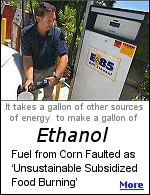
Here's another independent study: Published on
April 1, 2005 by Science Daily. Ethanol Production Consumes Six
Units Of Energy To Produce Just One. UC Berkeley bioengineering
professor Tad W. Patzek thinks that's a very bad idea.
For
two years, Patzek has analyzed the environmental ramifications
of ethanol, a renewable fuel that many believe could
significantly reduce our dependence on petroleum-based fossil
fuels. According to Patzek though, ethanol may do more harm than
good."In terms of renewable fuels, ethanol is the worst
solution," Patzek says. "It has the highest energy
cost with the least benefit.” Plus, it will create a
shortage that will drive up food prices and will hurt the
poorest people at home and around the world.
Now
lets jump to 2008.
Associated Press / April 4, 2008
NEW YORK - Corn prices jumped to a record $6 a bushel yesterday,
driven by an expected supply shortfall that will only add to
American's growing grocery bills and further squeeze struggling
ethanol producers. Corn prices have shot up nearly 30 percent
this year amid dwindling stockpiles and surging demand for the
grain used to feed livestock and make alternative fuels. Prices
are poised to go even higher after the US government this week
predicted American farmers - the world's biggest corn producers
- will plant sharply less of the crop in 2008 compared to last
year. (Because, now they can make more money planting soy
beans).
Worldwide demand for corn to feed livestock
and to make biofuel is putting enormous pressure on global
supply. And with the United States expected to plant less corn,
the supply shortage will only worsen. The Department of
Agriculture projected that farmers will plant 86 million acres
of corn in 2008, an 8 percent drop from last year.
While
corn growers are reaping record profits, US consumers can expect
even higher grocery bills - especially for meat and pork - as
livestock producers are forced to pass on higher animal feed
costs in addition to thinning their herd size.
In
addition, corn and corn syrup are used in an array of products,
meaning the price of everything from candy to soft drinks will
eventually go up.
The 147 US ethanol plants have the
capacity to produce 8.5 billion gallons of fuel a year,
according to the Renewable Fuels Association. Corn is the basic
feedstock for most of the plants and about 20 percent of last
year's 13 billion bushel corn crop was consumed by ethanol
production.
That percentage is expected to increase to
30 percent for the next crop year, which ends Aug. 31, 2009,
according to Terry Francl, a senior economist for the American
Farm Bureau Federation.
Do you agree, that it's time
for second thoughts on the use of taking food and making fuel
out of it? Americas renewable energy policy has been an
unfolding failure and it's time for the Members Of Congress to
wake up to the truth and repeal the Ethanol mandate and stop
this insanity.
It's time for us to write our members
of Congress and demand a review of the Ethanol mandate. So now
we know why eggs cost over $2 a dozen. A loaf of bread costs
over $2. Flour prices have nearly tripled. Milk costs over $4.50
a gallon. Meat prices are soring along with every other
consumable. In the last 2 years with energy and food prices
soaring it now takes an average of $2.50 for same products that
used to cost $1 dollar and it will continue to get worse unless
something is done.
What's happening around the world
because of the energy crises? Global Food Crisis Expected to
Produce Social Unrest By Susan Jones CNSNews.com Senior Editor
April 03, 2008
(Editor's note: Corn prices jumped to a
record $6 a bushel on Thursday 4/3/08.)
World Bank
President Robert Zoellick says a global food crisis demands the
immediate attention of world leaders.
Biofuels In his
speech on Wednesday, Zoellick mentioned biofuels as one the "realities"
that will keep food prices high for years to come.
The
Energy Policy Act of 2005 passed by Congress and signed by
President Bush increases the amount of biofuels (usually
corn-based ethanol) that must be added to gasoline sold in the
United States.
But diverting corn from food to fuel
use has raised food prices, the Heritage Foundation noted.
Corn
cost about $2 a bushel when the 2005 law was signed, but it's
now selling for more than $5 -- "primarily because a
quarter of the crop is now used to produce energy," wrote
Ben Lieberman, a senior policy analyst at Heritage.
Moreover,
the price of corn-fed meat and dairy products has jumped as
well, and wheat and soybean prices are also rising, because
acreage once devoted to those crops is now going to corn
But
there is no let-up in Congress: On Tuesday 4/1/08, House
Democrats pressed the nation's top oil companies to invest 10
percent of their profits in renewable energy, including
biofuels. I wonder if Congress lives in the same world we live
in? Do they know or even care about the consequences of their
actions. If these top oil companies invest 10 percent of their
profits in biofuels it will cause a bigger disaster. Congress
thinks they are punishing these companies for making obscene
profits, but the bottom line is, it will just cause prices to go
higher.
Hoarding and panic is already beginning, as
more and more crops are converted to energy. Producing fuel
instead of food for people and livestock, will cause the food
shortage to get worse.
The growing food shortage is
casting a shadow across the globe, causing riots in Africa,
consumer protests in Europe and panic in food-importing
countries.
Milk powder prices rose from $2,000 to
$4,800 per ton last year as rising consumption of milk products
in Asia coincided with shortages in the Western world. Drought
in Australia has worsened the problem as have government
policies in Europe and America to increase the use of biofuels.
Farmers worldwide are worried about feed costs. In
Europe pig and poultry breeders are threatening to cut
production unless they are paid higher prices.
In the
United States our economy is being destroyed, the value of the
dollar is at an all time low and is dropping like a ton of
bricks, again with no end in sight.
A few weeks ago
president Bush in a press conference said, “our economy is
in a slowdown,” but we shouldn't worry, because his new
stimulation package of $150,000,000,000 (that's billion) dollars
should help our struggling economy. (What a joke). Where are
they getting this 150 billion.
Oh, I know how they
will do it. Start up the printing presses and print more money.
And then they will lower the interest rates again and the dollar
will continue it's free fall. Of course the fallout from these
actions will excel the cost of energy, food and everything else
that we consumers need to survive.
Our once great
republic is broke. We are now the biggest debtor nation on the
face of the earth and our governments solution is to just print
more money. It doesn't make any sense at all, and just like
throwing more fuel on a roaring fire. (no pun intended.)
The
only thing that will continue to drop is the value of our homes,
if you still have one. Great.
|
 . .
This site is Under Construction, and some
links do not work. Please check back later.
|
|









 2008 James Itterly - Princeton, Minnesota. All rights reserved.