|
| August 22, 2007 |
|
 |
Ignoring Clint Eastwood's
advice in "Dirty Harry" that opinions, like
certain body parts, are best kept to yourself.
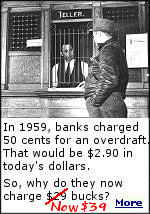
Why Overdrafts Cost $29
$39 (or more)
When
I started working at the bank in 1959, we charged 50¢
for an overdraft, and that was per-day, not per-item. I
remember a farmer coming into the bank to complain about the
fee. Back then, we always wanted to keep the customer happy,
and his 50¢ was promptly refunded.
So, how did
we get from half-a-buck to what banks are charging today for
this service? Well, a lot of it has to do with the same
reason a Black Lab licks himself. Because he can. Over the
years, banks have figured-out they can make small increases,
usually on an annual basis, and who is going to complain?
The bulk of their deposits come from about 20% of their
customers ( the old 80/20 rule ), but in recent years a
large chunk of their income has come from that 80% who don't
keep much money on deposit. How can that be?
These
are the people banks love to hate. Every bank has a group of
customers that are on the short-list every week, some every
day, and they're charging the heck out of them. If the
customer complains, the answer is simply a suggestion they
keep better records, or "don't write the check
until you have the money", or the mother of all
replies, "Why don't you take your account somewhere
else??"
Banking's big secret is, that
about one-half of their after-tax income comes from
overdraft and return check charges.
Appealing for
a refund does little good, once they take the money out of
your account, they don't want to give it back. I remember we
had a restaurant owner who used to be on the list almost
every day. I figured, that if the guy could get one day
ahead, he'd never be on the list again. He paid us nearly
$1,000 a month in overdraft fees. He was, absolutely, our
best customer. So, how was he treated? We treated him like
dirt. His name came up one day in a meeting as the guy who "paid
us enough to cover our employee Christmas Party and all the
employee gifts", and everyone laughed.
Over
the years, banks learned that no matter what they charged
for a bad check, they could get it. The customer writing
short checks hardly ever leaves your bank, where is he going
to go? Every bank is charging similar rates, and when the
rates go up across the street, up go yours. So, over time,
they are where they are today. Applying inflation factors to
that 50¢ back in 1959, the fee should only be about $3
bucks today. The government isn't about to step-in and
throttle these fees, in fact bank examiners will sternly
grill any bank president who is not making his bank more
money this year than last. To them, good profits equate to
safety and soundness.
The banking industry does
what it can to protect what it has going, keeping
competitors out of their markets, and maintaining a good
relationship with politicians, often by contributing to
political campaigns. In addition to the State banking
associations efforts, The American Bankers Association
contributes plenty to both major parties. Here is a list of
what they gave in
recent
years.
So, if you happen to be on that
short-list of people your bank loves to hate, what can you
do to improve on the situation? Make it your goal to never
be overdrawn again. If your bank offers online banking,
sign-up for it, and get in the habit of checking your
account daily. If they offer tranfer ability from other
accounts, or a credit line, take them up on it. If there is
a mid-day cut-off for accepting deposits, get it there on
time.
With three kids in college, and a wife with
her own account, I check balances every day, and once in a
while I have to roar-down to the bank at the last minute to
prevent a financial tragedy. One day, I stopped in to make a
deposit to one of the accounts about noon, and the teller
smiled sweetly and said, "Oh, it is 3 o'clock
already??"
About that 3:00 pm cut-off in
the lobby, why do they do that? In the old days before
computers, banks needed to do that so the staff could take a
coffee-break and then go to the back room and process all
the work that had come in that day. Checks drawn on other
banks needed to be mailed to the Federal Reserve, or be
ready for the courier to pick-up. The tellers needed time to
balance their windows, and make final accounting entries.
There was a lot of work to be done before heading home at
night.
Technology has changed much of that, but
the 3:00 pm cut-off is still around in most banks. A few
years ago, I was president of a bank about an hour drive
from Denver, Colorado. A customer came in one day, saying
that he could never get to our drive-up window in time with
his paycheck, and that some times resulted in an overdraft.
"Why do you have to cut-off at 3 o'clock?",
he asked. I checked into it, and learned that the only real
reason was, the courier taking the checks to the Federal
Reserve in Denver came at 5:00 pm. So, I called the armored
car company and they had another truck that came by every
night at 9 o'clock. I changed to the later courier, and
announced to everyone that a deposit made today is credited
today, and that solved the problem.
A couple of
months later, the owner of the bank called to ask me why our
overdraft income was down.

Global
Air Aviation Referral Service
I welcome responses,
and will be glad to post them here. Email your remarks to
ron@global-air.com |
|
Here's one for you. My bank used to pay checks like
other banks, the smaller items first, leaving the larger
items for last. That always seemed like a fair system, and
if there was an overdraft or return check, it always
resulted in fewer checks being involved. But a genius 29
year-old vice president down at the bank figured out that,
if they paid the checks in CHECK NUMBER ORDER instead, it
would statistically increase the number of checks that
couldn't be covered with the available balance.
For
example, let's say you have $100 in the bank, and 4 checks
show-up for payment: #1501 for $90, #1502 for $20, #1503 for
$25, and #1504 for $50. Under the old system, the one most
banks use, checks # 1502, #1503, and #1504, totalling $95
would be paid, leaving $5. So, if the bank then goes ahead
and pays check #1501, you would be $85 overdrawn, and the
bank would charge you a single $29 fee.
But, thanks
to that 29 year old vice president's brilliant idea, the
bank would pay #1501 first, leaving just $10, and the other
checks would create a 3-check overdraft, and an $87 fee for
that day. The bank screwed-me over for an additional $59,
thanks to the new system.
So, after I figured this
out, I carry two pads of checks in my checkbook. For all
checks under, say, $50, I use the pad with the
lower-numbered checks. For all larger checks, like my
mortgage payment, I use the second pad of higher-numbered
checks. And sure-as-shootin', one day, my mortgage payment
came in, along with a couple of smaller checks, but because
the big check was a much higher check number, the bank could
only charge me a single overdraft fee.
I went
right down to the bank to make a deposit, and while I was in
the lobby, the young officer came over and said, "Hey,
we noticed you are writing checks out of order in your
checkbook... is there a problem?" I just smiled, and
said, "No, no problem..." and left the bank. The
%*^&#.
Larry - Minnesota
As a retired banker, I remember we had to push "credit
life" insurance to loan customers. That was one of the
worst expenditures of money you could find. Every loan
officer had a good story to tell about Mrs. Smith or Jones,
whose husband died, and their loan got paid off. Obviously,
if they were concerned about that, any number of term life
policies were available on the market from various companies
for a fraction of the cost. At our bank, we paid the
officers bonuses based upon how many people they could screw
on the credit life scheme. Lenders that did not push the
product were looked down upon, and could kiss their future
goodbye because they were not "team players". Most
of the installment loan officers were so brain-washed they
actually believed in the product.
I remember when
someone lost their checkbook and reported it to the bank. We
charged them a stop-payment fee for letting us know. Hell,
if someone used their check and forged a signature it was
the bank's problem not the customer's. It would have made
more sense to pay them if they notified us and a forged
check came in.
David J. - Texas
|
|
|
Most
Recent Editorial
Recent
Global
Air Links:









|