From 2008: June, 25, 1966 the 90th
Anniversary of Custer's Last Stand. Hazel Ehrnreiter was working
at the First National Bank of Anoka, I was a bank examiner for
what is now U.S. Bank, and we were about to get hitched. At age
22, neither of us had much money, but we weren't going to wait
for prosperity to kick-in. When you are young and in love,
sometimes money isn't a factor in the decision-making process.
Getting
Married with a Hundred Bucks
A visit to the Battle of Little Bighorn in Montana can
provide greater understanding of Custer's Last Stand, and
the motivations of the combatants. More
Human
bones, bits of leather, shreds of uniforms and spent gun
cartridges by the thousands. These were the clues of a mystery
dating back to 1876, to a grassy Montana hillside where more
than 200 sweaty and dust-covered troopers under Lt. Col. George
Armstrong Custer were wiped out - to a man - by about 4,000, or
more, Indians with modern repeating rifles and battle
experience. More
The
soldiers under Reno and Benteen were rescued by the arrival
of General Alfred Terry and his army. More
Son of the Morning Star
The entire 3 hour 1991 television epic of
Custer's Last Stand.
From
a 2020 review of the film: "For the more
ambitious stuff, there’s Son of the Morning Star, which to
this day is considered to be the most historically accurate
portrayal of Custer’s Last Stand, and the events leading up
to it (plus the character study of the man himself). And this
film shows him warts and all. Shows why he’s considered to
be such a bastard (how he treated the Indians, his ego and
stubbornness, not taking criticism very well).
263
men of the 7th Cavalry engaged an overwhelming number of
Lakota and Cheyenne, in one of the Indian's last armed
efforts to preserve their way of life. More
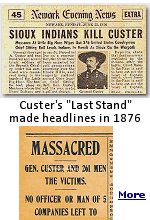
''General
Custer Attacks Their Camp, Himself and Seventeen Officers
Killed, Together with Three Hundred and Fifteen Soldiers.''
Those were published at the top of the front pages on July
7, 1876. Weekly papers in those days, in an era when news
still traveled slowly and readers were patient in learning
of it, they published the account of Custer's historic final
battle nearly two weeks after the event took place. More
June 25th is the anniversary of one of the
worst management decisions of all time. On that day in 1876, Lt.
Col. George Armstrong Custer made a decision to engage an
overwhelmingly superior force of more than 2,000 Lakota Sioux,
Cheyenne and Arapaho warriors with only 210 members of the 7th
U.S. Cavalry along the Little Bighorn River. Giving your life is
the ultimate price for a bad decision, but Custer's
decision-making was especially poor in so many ways. More
Updated
10:30
AM CDT June 25, 2026 Be
sure you are looking at the latest homepage by clicking Refresh
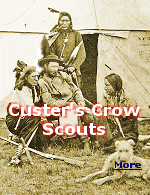
There
were six of them, warriors of the Crow or Absarokee nation, who
rode with Custer on his last march down the Little Big Horn
River in Montana that day in June, 1876. When the leader of the
Seventh cavalry asked General Terry for his best Crow scouts,
Terry told him he could have Curley, ''White Man Runs Him,''
Hairy Moccasin, ''Goes Ahead,'' Yellow Face and White Swan. The
Crows were glad to serve with Custer and they guided him to
locate the hostile camp on the Little Bighorn.
Before
the battle, Custer's scouts took him to a high plateau a few
miles away that overlooked what would be the battle location, so
he could see the Indian camp across the river. They estimated
10,000 Indians with perhaps 2,000 or more warriors and several
thousand horses. Custer could not see the village because of all
the dust, most likely caused by the horses running around, and
not being a man to take advice, discounted the information.
More























 2000 - 2026 Global Air Aviation Referral Service by